Elevating Creative Publishing with Customizable Mother's Day Cryptogram Puzzles
For the modern independent creator, the digital marketplace offers unparalleled opportunity, but also demands unique and adaptable content. The concept of a 17 Mother's Day Cryptograms Word Puzzles package represents more than just a collection of games; it is a foundational toolkit designed for flexibility, efficiency, and brand differentiation. This product exemplifies a shift towards modular, editable digital assets that empower professionals to build distinct offerings without starting from scratch.
Understanding the Cryptograms Product Core
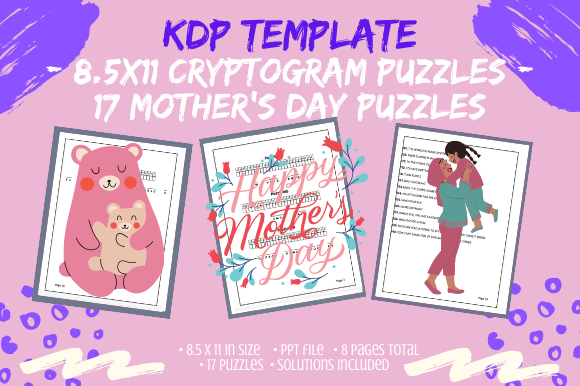
This specific interior package is a ready-to-use set of 17 word puzzle cryptograms themed around Mother's Day, tailored for activity book publication. Cryptograms are classic substitution puzzles where letters are encoded, requiring solvers to decode a hidden quote or message. The provided file includes the puzzles and their solutions formatted for an 8.5 x 11 inch book interior with no bleed, making it technically compliant for platforms like Amazon KDP (Kindle Direct Publishing). Crucially, it is delivered as an editable PowerPoint (PPT) file, emphasizing its role as a template rather than a final product. The explicit guidance to modify titles, add clip art, integrate other games, or rearrange pages underscores its primary value: a customizable starting point.
Alignment with Industry and Market Trends
The offering directly intersects with several prevailing trends in the creative and publishing economy. First is the massive growth of the activity book and puzzle market, catering not only to children but increasingly to adults seeking mindful relaxation and cognitive engagement. Second is the rise of the creator economy, where freelancers, entrepreneurs, and side-hustlers leverage digital tools to build micro-businesses. A template like the 17 Mother's Day Cryptograms Word Puzzles reduces time-to-market and technical barriers for these individuals.
Furthermore, it addresses a critical industry demand for content differentiation. Amazon KDP and similar platforms actively scan for duplicate content, which can penalize listings that are too similar. By providing a base that must be altered and personalized—through added coloring pages, changed titles, or mixed graphics—the product inherently guides users toward creating something “all your own.” This practice aligns perfectly with platform guidelines and consumer expectations for original work.
The Shift in Creator Workflows and Expectations
Today’s content creators have evolving needs. Efficiency is paramount, but not at the expense of authenticity. They seek workflows that allow for:
- Speed and Scalability: Using a pre-formatted, dimensionally correct interior saves hours of design and layout work.
- Creative Control: An editable PPT file offers a familiar, accessible medium for customization without requiring advanced graphic design software.
- Strategic Adaptation: The ability to decompose the booklet and mix it with other game types enables creators to develop hybrid products—for instance, a combined cryptogram and sudoku book—to target niche audiences.
The recommendation to “make a duplicate copy to work with” reflects a practical, professional approach to digital asset management, ensuring the original investment remains intact for future iterations or different holiday themes. This forward-looking methodology supports sustainable creative operations.
Why This Approach Gains Attention
Professionals are paying attention to such templated offerings because they represent a smart balance between production and innovation. For a marketer or entrepreneur, the core value lies in the contextual application. A Mother’s Day theme has immediate seasonal relevance and emotional resonance, making it a commercially viable niche. However, the underlying structure—the cryptogram puzzle mechanics—is perennial. By owning an editable file, a creator can theoretically repurpose the framework for Father’s Day, birthdays, or other occasions, simply by changing the encoded quotes and visual theme.
This connects to larger developments in digital product design for scalability. The most successful digital creatives are not merely selling one-off items; they are building systems and asset libraries. A well-designed puzzle interior becomes a component in that system, reusable and adaptable across multiple projects, thereby increasing the return on the initial acquisition.
Practical Applications and Observations
Consider a freelance graphic designer expanding into KDP publishing. They might use the 17 Mother's Day Cryptograms Word Puzzles PPT file as a core, but then:
- Integrate their own custom illustrations to elevate the visual appeal.
- Add a few pages of heartfelt Mother’s Day quotes to break up the puzzle sections.
- Change the title to “A Puzzle Celebration for Mom” to better reflect their brand voice.
- Combine it with a different puzzle type from another template they own, creating a more comprehensive “Mom’s Activity Book.”
The final product is distinctly theirs, yet the foundational work—the cryptogram puzzle creation, the solution key formatting, the page layout—was efficiently handled. This observational example highlights how such tools are used in real-world creative workflows to achieve both quality and uniqueness.
Connecting to Broader Developments
The relevance of modular, editable content like this extends beyond puzzle books. It mirrors trends in website templates, social media content packs, and digital course materials. The market increasingly favors configurable expertise. Consumers buy the know-how and the structured format, then apply their own creativity to finalize the product. This model respects both the provider’s specialized skill (in designing engaging cryptograms) and the buyer’s individual brand needs.
In technology, the move towards open-file formats (like PPT) that are widely compatible supports collaboration and ease-of-use. It lowers the technical barrier, allowing enthusiasts with good ideas but limited design skills to participate in the marketplace. This democratization is a key driver in the expansion of niche publishing.
Ultimately, the 17 Mother's Day Cryptograms Word Puzzles package is more than a product listing. It is a case study in modern digital creation: providing the robust, compliant skeleton upon which professionals can build their own unique, market-ready, and personally branded offerings. It acknowledges that today’s successful creators are assemblers, curators, and innovators, needing tools that are as flexible and forward-looking as their business ambitions.