The ASTRO DIARY PLANNER 2023: A Structured Tool for Celestial Observation
For anyone engaged with astrology, whether as a student, practitioner, or a curious enthusiast, the core practice involves consistent observation and recording. The planetary movements, lunar phases, and their perceived correlations with daily events form a complex data set. Without a dedicated system to log this information, insights remain fragmented and ephemeral. The ASTRO DIARY PLANNER 2023 addresses this fundamental need by providing a purpose-built, physical framework for tracking the celestial year. Its value lies not in offering interpretations, but in delivering a reliable, customizable structure that supports both disciplined study and creative reflection.
Core Purpose and Key Characteristics
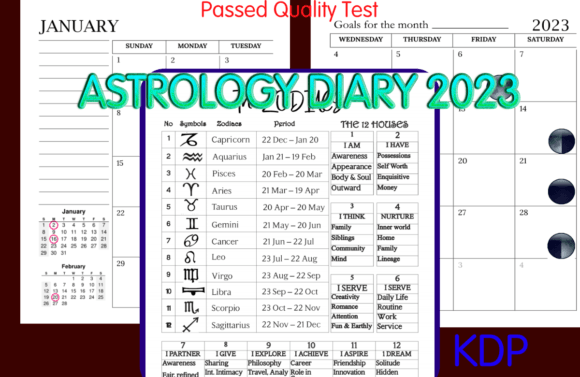
This planner is distinctly a tool, not a book of readings. Its primary function is to serve as a centralized log for 2023’s astrological events and your personal notes alongside them. The design pivots around two main tracking components: planetary transits and lunar cycles. Each month typically includes dedicated sections for noting key transit dates, such as when planets change signs or station retrograde, alongside the phases of the moon. This dual focus allows users to observe the interplay between longer planetary influences and the more rapid monthly lunar rhythm.
A practical strength is its preparation for self-publishing. Created with Affinity Publisher, and including all source documents, the planner is described as KDP-ready for upload. This indicates a significant degree of flexibility. For the end-user purchasing the printed version, this backend detail translates into a clean, professional layout optimized for the stated 8x10-inch dimensions. For those with publishing skills, it offers the rare opportunity to edit and adapt the core structure—perhaps to add localized ephemeris data or personalize design elements—before printing their own copies.
Evaluating Usability and Daily Application
In real-world use, the utility of any planner depends on its integration into one's routine. The ASTRO DIARY PLANNER 2023 is likely to perform well for individuals who already engage with astrology daily or weekly. Its large page size provides ample space, preventing the feeling of cramped notes. A user might, for example, note Jupiter’s entry into a new sign on the relevant date, and then journal a few observations over the subsequent weeks about opportunities or expansion in their life. Simultaneously, they could track the Full Moon of that month, recording emotional reflections or project culminations.
The separation of celestial data from personal logging space is crucial. It prevents the clutter that occurs when trying to combine pre-printed ephemeris information with personal diaries in a standard notebook. Consistency is maintained through the uniform layout across months, enabling a reliable pattern of use. Reliability, in this context, refers to the planner’s physical role as a dependable repository. Its effectiveness is directly tied to the user's consistency in filling it, but the structure removes the organizational burden, making that consistency easier to achieve.
Presentation and Long-Term Value
The presentation, given its professional design foundation, should be clear and functional. Headings for transits and lunar cycles will be prominent, with structured areas for writing. The long-term value is archival. After 2023 concludes, the filled planner becomes a complete, personalized record of that astrological year. This allows for retrospective review and pattern recognition that is impossible with scattered digital notes or disparate journal entries. For an astrologer building a case history or a student learning correlations, this compiled physical record is a significant asset.
Primary Beneficiaries and Practical Scenarios
The planner is uniquely designed for both beginners and experts, but each group will use it differently.
For the beginner astrologer, it serves as an educational scaffold. By having to actively look up and write down major transits and moon phases, the beginner engages in a learning process far more effective than passive reading. It builds familiarity with astrological terminology and the rhythm of celestial movements. The beginner benefits most by using it as a companion to an astrology course or foundational books, jotting down their questions and observations next to the official dates.
For the expert or professional astrologer, it functions as a streamlined client log or research notebook. When consulting with clients, an astrologer can quickly reference the month’s key transits noted in the planner and correlate them with client questions. It can also be used to track the astrological weather alongside personal business metrics, creative output, or collective events, building a data set for professional insights. The space allows for concise, professional note-taking that can be referenced later.
Professionals, entrepreneurs, and creators who apply astrology strategically—for planning marketing campaigns, product launches, or content cycles—will find this planner a practical bridge between celestial timing and project management. By logging lunar phases (e.g., New Moons for initiation) alongside project milestones, they can cultivate a tangible record of their timing experiments.
Observations on Flexibility and Possible Limitations
The inclusion of source files for editing is a notable feature that adds a layer of flexibility uncommon in pre-printed planners. A savvy user could, for instance, add columns for specific planetary aspects or integrate their own symbolic system. However, the standard version’s utility depends entirely on the user supplying the astrological data to fill it. It does not contain a pre-filled ephemeris for 2023. This is a deliberate design choice, ensuring the planner remains a blank log for any astrological school or personal focus, but it is also a potential limitation for users who expect a complete reference. The user must be prepared to source transit and lunar dates from other calendars or software.
Another consideration is the physical format itself. A bound, 8x10-inch planner is substantial. It is less portable than a digital app but offers the cognitive and archival benefits of tactile, focused writing. For someone who prefers digital tools, this planner may not integrate well. Its value is maximized for those who appreciate and regularly use physical journals.
Integrating into Workflows and Projects
To determine if the ASTRO DIARY PLANNER 2023 fits your needs, consider your current practice. If you already jot astrological notes in random places and wish to consolidate, this planner provides immediate structure. If you are teaching astrology, it could be an excellent recommended tool for students to develop observational discipline. For content creators or marketers exploring astrological timing, it offers a clean testing ground to log campaigns against lunar cycles and review results objectively.
The key is to view it as a dedicated workspace. Its effectiveness grows with regular engagement. Setting a simple ritual, such as updating it each Sunday with the coming week’s known transits or checking it post-New Moon, can solidify its role in your workflow. For collaborative projects, like a podcast or publication focused on astrology, the editable source files allow a team to create a custom, shared version for tracking editorial themes against celestial events.
Ultimately, the ASTRO DIARY PLANNER 2023 stands out as a specialized, no-frills instrument. It does not promise mystical insights but offers a robust framework for capturing them yourself. Its worth is proven through consistent use, transforming the vast, moving chart of 2023 into a personal, documented journey. For the serious hobbyist, the professional, and the educator seeking to move beyond casual interest into methodical observation, this planner represents a tangible step towards deeper understanding and practical application.