The Modern Notebook: How the Kdp Winter Journal Reclaims Focus in a Digital World
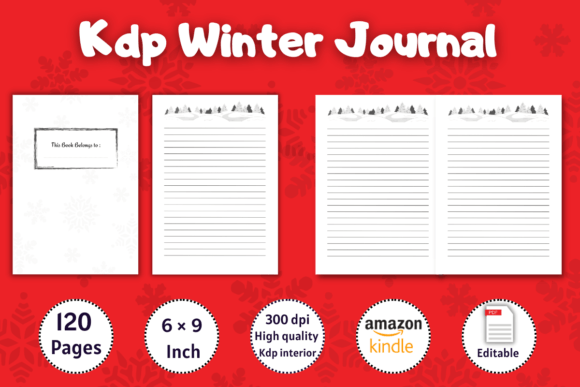
In an era defined by digital saturation and constant connectivity, a quiet revolution is taking place in the tools we use to think, plan, and create. The Kdp Winter Journal and its companion, the Kdp Winter Daily Journal Interior, represent more than just a simple notebook. They are a thoughtfully designed physical interface for the mind, catering to a growing desire for tangible, focused, and personal systems of organization. This 120-page, 6×9 inch notebook interior is not merely a product; it is a response to a cultural shift seeking balance between digital efficiency and analog depth.
The Resurgence of Analog Tools in a Digital Workflow
The broader trend is unmistakable. Professionals, creators, and students alike are increasingly integrating physical notebooks into their highly digital workflows. This isn't a rejection of technology but a strategic augmentation. Screens are for dissemination, collaboration, and storage; paper is for synthesis, deep thinking, and raw creation. The cognitive load of multitasking across apps and tabs can fracture concentration. A dedicated notebook, like the Kdp Winter Journal, offers a singular, uninterrupted space. Its 6×9 inch dimensions provide a substantial canvas for ideas without being cumbersome, fitting easily into bags and on desks, making it a portable sanctuary for thought.
This movement is driven by changing needs in knowledge work. The expectation is no longer just to manage information, but to connect and transform it into original output. Whether it's a marketer sketching a campaign narrative, a developer mapping a logic flow, or an entrepreneur brainstorming a business model, the initial, critical ideation often benefits from the unconstrained freedom of pen and paper. The Kdp Winter Journal serves as this ideal notebook interior, a blank slate where the friction of software interfaces disappears, allowing the hand and mind to work in direct concert.
Design Intent: The Philosophy Behind the 120 Pages
The specification of 120 pages is a deliberate design choice. It strikes a balance between commitment and flexibility. It is substantial enough for a significant project—a full academic semester, a professional certification study plan, a complete creative manuscript outline—yet not so vast as to feel daunting or unfinished. This encourages regular, habitual use and provides a tangible record of progress. Completing such a journal delivers a sense of accomplishment that a scattered collection of digital files often lacks.
The inclusion of an editable PDF file alongside the print-ready design speaks directly to hybrid workflows. It acknowledges that while the primary value is in physical writing, the need to digitize, share, or archive notes remains. A professional can jot down meeting insights in the notebook, then later transfer refined action items into a digital project management tool using the editable base file. This bridges the gap between the two worlds, making the journal a true hub in a modern productivity system.
Practical Applications: Beyond Simple Note-Taking
The utility of the Kdp Winter Journal interior extends far beyond generic note-taking. Its high-quality, print-ready design with no bleed ensures clarity and professionalism, making it suitable for contexts where the notebook itself is a work tool to be presented or reviewed.
- For Students: It becomes a dedicated homework and problem-solving log. Instead of loose sheets or disparate app notes, students can record lectures, solve equations, and draft essays in one sequential, organized volume. The physical act of writing enhances memory retention, and having all coursework for a subject in one place simplifies review and study.
- For Creators and Entrepreneurs: It acts as a development journal. Product ideas, user experience sketches, content calendars, and business metrics can be tracked over time. The linear format allows for observing the evolution of a thought from a rough sketch to a detailed plan, providing invaluable insight into one's own creative process.
- For Professionals and Freelancers: It serves as a client or project log. Meeting notes, project timelines, and feedback can be recorded in a secure, offline format. This not only safeguards sensitive information but also provides a reliable backup independent of cloud services or platform changes.
These examples underscore a key observation: the notebook has evolved from a passive receptacle to an active tool for process documentation. It captures not just the final output, but the messy, vital, and often insightful journey toward it.
Connecting to Larger Developments: The Search for Digital Mindfulness
The relevance of tools like the Kdp Winter Journal is amplified by larger developments in lifestyle and technology. The concept of "digital mindfulness" and intentional tech usage is gaining traction. People are consciously designing their environments to minimize distraction and promote deep work. A physical notebook is a cornerstone of such an environment. It requires no login, has no notifications, and offers no opportunity to switch tasks. It is a tool of pure intention.
Furthermore, in a market saturated with mass-produced goods, there is a growing appreciation for customizable, foundational tools. The Kdp Winter Daily Journal Interior, offered as an editable file, empowers users. It allows educators, coaches, or businesses to adapt the base design for specific purposes—adding branded elements, custom layouts, or instructional guides—before printing for their team or students. This aligns with the trend towards personalized productivity systems where the tool adapts to the individual's workflow, not the other way around.
The Enduring Value of the Physical Record
Finally, the Kdp Winter Journal speaks to an almost humanistic need for a tangible legacy of thought. Digital files are ephemeral in format and platform; a filled notebook is a permanent artifact. For enthusiasts documenting a hobby, a freelancer tracking their career growth, or a student preserving their academic journey, the completed journal is a meaningful object. It represents time, effort, and intellectual growth in a form that can be held, reviewed, and valued years later. This emotional and practical resonance is something purely digital systems have yet to replicate.
In conclusion, the Kdp Winter Journal and its interior design are significant because they meet modern needs with timeless principles. They provide a structured, high-quality, and flexible physical space that complements our digital ecosystems. By enabling focused creation, hybrid workflow integration, and personalized use, they address the core challenges of contemporary professionals, creators, and students: the need to think deeply, work intentionally, and leave a clear record of progress. In reclaiming the power of the notebook, we reclaim a part of our own attention and creativity.